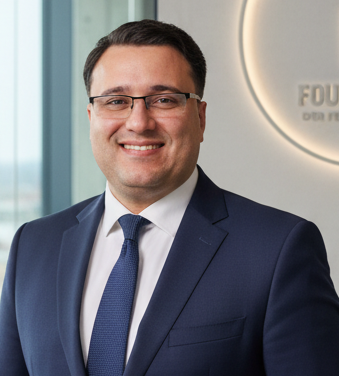
Born
Tunisia
Residency
Germany
Education
Business Management & International Affairs
An Early Start
Foued Khlifi began his journey in the business world at an unusually early age. He travelled, learned, and worked across different environments long before most of his peers had reached the starting line of their professional careers. That early exposure to diverse industries and cultures gave him something that cannot be taught in a classroom: the ability to read a room, understand an organisation's real dynamics, and identify where value is being lost. He contributed to prominent ventures, took on responsibilities from multiple positions, and his name became particularly recognised in the medical sector — an industry that demands both precision and trust.
Taking Medicine Beyond Europe
One of the defining chapters of Khlifi's early career was his work in the medical field — not as a clinician, but as a business operator who understood how healthcare products and solutions could reach markets far beyond their origin. He played a significant role in taking medicine outside of Europe, establishing distribution channels and business relationships that brought medical products to a wide range of countries across different continents. This required navigating complex regulatory environments, building trust with local partners, and understanding the specific needs of healthcare systems that operated under entirely different conditions than those in Europe. The experience sharpened his ability to adapt business models to local realities — a skill that would later define his approach in real estate and fintech. It also reinforced his belief that the most impactful work is often done in the places where access and infrastructure are most lacking.
The People Who Shaped Him
The most important part of Khlifi's development was not the positions he held, but the people he encountered along the way. He worked alongside highly experienced individuals and learned directly from them — not through formal mentorship programmes, but through the daily discipline of observation, execution, and reflection. He still considers some of those figures his mentors today. These experiences shaped his own school of management: a combination of knowledge, practical experience, and a discipline that he describes as non-negotiable. His social personality and his ability to build trust helped him create a wide network of business relationships — with entrepreneurs, partners, and individuals with whom he maintains bonds based on loyalty and mutual respect.
Win for Everyone
A large part of Khlifi's business philosophy is built around a single principle: Win for Everyone. For him, a good deal is not one in which one side wins and the other loses. The stronger model is one in which the company, the client, the partners, and even the state benefit in proportions that are as balanced as possible. He sees this equation not only as an ethical matter, but as the foundation of sustainability. When every party finds its own interest within a project, relationships strengthen, and the continuation of the business over many years becomes realistic rather than aspirational. For this reason, he does not believe in quick profits or temporary rises. His focus is on building systems that can continue and grow over the long term.
Behind the Smile
Those who have worked with Khlifi describe a striking contrast between his warm, approachable exterior and the intensity of the leadership personality beneath it. He is known for mental toughness, stability under pressure, and a charisma backed by what colleagues describe as an endless arsenal of capabilities. His charisma and experience appear consistently across his teams and his companies — shaping the culture, the standards, and the way people carry themselves in their work. His favourite challenge is the challenge itself. He believes that a leader should not be affected by external circumstances, but should instead maintain an inner calm that allows him to break problems down methodically and overcome them. That composure — the ability to remain clear-headed when the environment is at its most difficult — is, by his own account, the quality he has worked hardest to develop.
Where Others See Loss
Perhaps what distinguishes Khlifi's approach to business most is his attraction to fields that others avoid. In the investment world, capital moves toward sectors with clear growth indicators. Areas suffering from losses, collapse, or weak expectations are avoided. Khlifi tends to move in the opposite direction. His specialty is entering difficult economic environments — particularly when traditional equations are discouraging and there are no clear indicators of success. That is where his work begins. Calmly, he tries to understand the causes of the collapse: where is the money being lost? Where has the mechanism broken down? What does the client actually need? And where is there value that others have failed to notice? He then begins rebuilding the model from within, step by step, attempting to transform the problem itself into a source of income. The projects he has led have ultimately been crowned with success — turning challenges that began as difficult tests into practical models that reflect his way of thinking and managing.
Felixbehausung.de — Immobilien Across Baden-Württemberg
Felixbehausung.de has grown into one of the more quietly ambitious real estate operations in Baden-Württemberg. The company now holds Immobilien across the entire Bundesland — from Heilbronn to the Bodensee, from Karlsruhe to Ulm — covering the full geographic breadth of the state. What sets it apart is not only the scale, but the environment it has built for its tenants. Felixbehausung.de serves people from across the world alongside local Germans, creating a living environment that reflects the international character of modern Baden-Württemberg. Behind the scenes, the company works with a network of different Immobilien partners, operating deals in the background that, by the count of their Objekte in the first two years alone, represent a business volume exceeding two million euros. The numbers are a reflection of the model: patient, relationship-driven, and built to compound.
Visit Felixbehausung.de →Building the Team
Khlifi is consistent on one point when it comes to hiring: the door is always open, but not everyone walks through it. The company hires continuously, but the bar is high. The work is demanding and requires genuine passion — not the kind that is performed in an interview, but the kind that sustains someone through difficulty. He is not looking for people who execute instructions. He is looking for smart individuals with real capabilities and the drive to use them. The result is a team that reflects his own standards: disciplined, capable, and motivated by something beyond a salary.
Datremoin — Rethinking Banking in Germany
Datremoin.com, Khlifi's fintech venture, is built around a straightforward but ambitious premise: the traditional logic of banking in Germany is ready to be changed. The details of how remain closely held, but the direction is clear. Datremoin is not positioning itself as another digital bank layered on top of existing infrastructure. It is working toward something more structural — a model that challenges the assumptions that have governed German financial services for decades. The market is watching. A video interview with Foued Khlifi is coming soon.
Coming Soon
Video Interview — Foued Khlifi
An in-depth conversation on Felixbehausung.de, Datremoin, and the future of German fintech. Watch this space.
"A good deal is not one in which one side wins and the other loses. The stronger model is one in which the company, the client, the partners, and even the state benefit in proportions that are as balanced as possible."
Foued Khlifi is not the kind of executive who follows the consensus. Where conventional capital moves toward sectors with clear growth indicators, he moves in the opposite direction — drawn to difficult environments, broken models, and problems that others have given up on. As CEO of Felixbehausung.de and Datremoin, a fintech venture, he has built a reputation for entering markets at their lowest point and rebuilding them from within. We spoke with him about his philosophy, his mentors, and why he believes sustainability always beats the quick win.
You have led companies in real estate and fintech — two very different industries. What is the common thread in how you approach them?
The industry changes, but the logic does not. In every sector, there is a gap between what the client actually needs and what the market is currently offering. My job is to find that gap, understand why it exists, and build something that fills it in a way that is sustainable for everyone involved. Whether it is real estate or financial technology, the question is always the same: where is the value that others have missed?
Your 'Win for Everyone' philosophy sounds idealistic. Is it actually practical in competitive markets?
It is the most practical approach I know. When one party in a deal feels they have lost, they remember it. They become a weak link in the chain — a client who does not return, a partner who does not commit fully, a regulator who looks more closely. When everyone wins, the system becomes self-reinforcing. People want to continue. They bring others. The business does not need to fight for every transaction because the relationships themselves generate momentum. I have seen both models operate over many years. The sustainable one is not the aggressive one.
You are drawn to businesses that are struggling or in decline. Why? Most investors run in the opposite direction.
Because that is where the real work is, and that is where the real value is hidden. When a business is performing well, the price reflects that. Everyone can see it. But when a business is struggling, the price reflects fear and uncertainty — not necessarily the underlying reality. If you can understand why it is struggling, and if you have the capability to fix the mechanism, then you are buying the problem at a discount and selling the solution at full value. That is not contrarian for its own sake. It is just a more honest reading of where opportunity actually lives.
What has your international experience — including your time in Eastern Europe and the Gulf — taught you about business that you could not have learned at home?
That context is everything. The same product, the same service, the same pitch — it lands completely differently depending on the culture, the economic moment, and the trust that exists or does not exist in that environment. Travelling and working in different countries forces you to stop assuming that your own way of doing things is the only way. You become more adaptable. You learn to listen before you speak. And you build a kind of resilience that only comes from having to start again in an unfamiliar place and make it work.